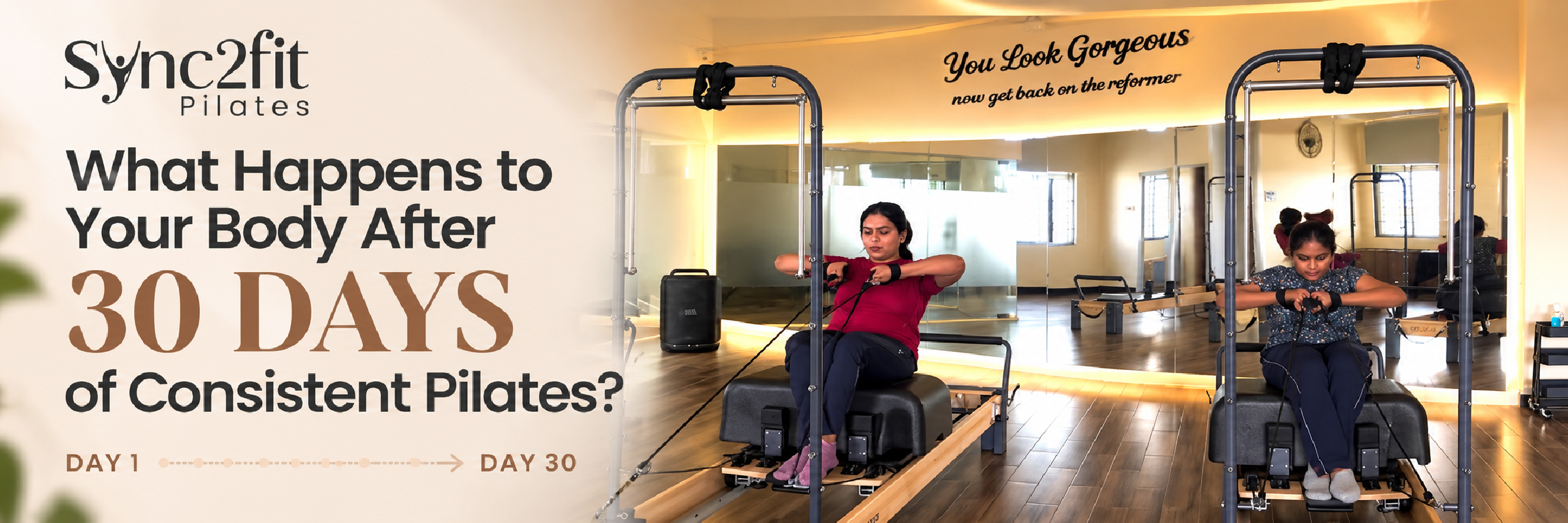
Thirty days of consistent Pilates can be a meaningful starting point for understanding how your body responds to regular, controlled movement. While the exact results vary from person to person, maintaining a regular Pilates routine may help you become more aware of your posture, movement patterns, core engagement, flexibility, balance, and overall physical control.
The key word is consistent. Pilates is not about completing the hardest workout possible every day. It is about practicing controlled movements regularly and allowing your body to gradually adapt.
If you’re wondering, “What can I realistically expect after 30 days of Pilates?”, the answer depends on your starting fitness level, how frequently you train, your exercise technique, recovery, nutrition, sleep, and other physical activities.
Let’s explore what may change during your first month.
What Does 30 Days of Consistent Pilates Actually Mean?
Before discussing results, it is important to understand that 30 days does not necessarily mean doing an intense Pilates workout every single day.
A sustainable routine might involve several structured sessions per week, combined with appropriate recovery and other forms of movement.
Consistency means giving your body repeated opportunities to practice the same fundamental principles:
- Controlled movement
- Breathing
- Core engagement
- Alignment
- Balance
- Mobility
- Coordination
- Body awareness
If you’re completely new to Pilates, starting with Beginner Pilates classes in RR Nagar can help you learn fundamental movements under professional supervision rather than trying to progress too quickly.
For more information about starting Pilates, you can also explore A Beginner’s Guide to Pilates Classes in Bengaluru.
Week 1: Your Body Starts Learning
During the first week, you may not notice dramatic physical changes—and that’s completely normal.
Instead, your body is learning.
You may begin to notice how you hold your shoulders, how you position your pelvis, how you breathe during movement, or how much effort is required to maintain control during an exercise.
For beginners, even basic Pilates movements can feel challenging because they require concentration and coordination.
You may also experience muscle soreness when introducing your body to movements it is not accustomed to.
This initial stage is less about visible transformation and more about developing movement awareness.
Pilates places considerable emphasis on technique and control, so learning the fundamentals properly can create a stronger foundation for future progress.
Week 2: Better Awareness and Control
With continued practice, you may start recognizing certain movements more easily.
You might notice that you can maintain a position for longer, coordinate your breathing with movement more naturally, or understand how to engage your core more effectively.
This is one reason Pilates training in Bangalore can be valuable for people who want structured movement practice rather than simply exercising for intensity.
Your progress may be subtle.
Perhaps your posture feels more intentional while sitting at your desk. Maybe you notice that you are paying more attention to your alignment while walking or exercising.
These changes are not necessarily dramatic, but they can indicate that your body awareness is developing.
If you’re interested in this aspect of Pilates, read How Pilates Improves Body Awareness and Everyday Movement.
Week 3: Building Strength and Stability
By the third week, consistency may begin to make exercises feel more familiar.
Your core, hips, shoulders, legs, and other muscle groups are repeatedly being challenged to work together through controlled movement.
This doesn’t mean that everyone will experience the same level of strength improvement within three weeks. Your results will depend on your current fitness level and training frequency.
However, regular practice can help you become more comfortable with exercises that previously felt unfamiliar.
People looking for Core strength training Bengaluru may find Pilates particularly useful because many Pilates movements require controlled trunk stability while the arms and legs move.
Core training isn’t only about visible abdominal muscles. It also involves learning how to control and stabilize your body during movement.
For a deeper look at this topic, you can read 7 Benefits of Reformer Pilates for Core Strength and Posture.
Week 4: Feeling More Connected to Your Movement
After approximately four weeks of regular practice, you may begin to notice that Pilates movements feel more familiar.
You may find it easier to understand instructions, maintain better control, or recognize when your alignment needs adjustment.
This is where consistency becomes particularly important.
Instead of simply completing an exercise, you may begin to understand how you’re performing it.
That difference matters.
Pilates encourages you to pay attention to breathing, alignment, control, precision, and coordination. With repeated practice, these elements can become more familiar.
Some people may also notice improvements in flexibility or balance, although the degree of change differs between individuals.
For more information, explore Can Pilates Improve Balance and Coordination? and How Pilates Improves Flexibility and Helps Prevent Injuries.
What Physical Changes Can You Expect After 30 Days?
There is no universal “30-day transformation” because everyone’s body and starting point are different.
However, consistent Pilates may help you work toward several areas of physical development.
1. Improved Core Control
Repeated Pilates practice can help you become more familiar with engaging and stabilizing your core during movement.
2. Greater Body Awareness
You may become more conscious of your posture, alignment, breathing, and movement habits.
3. Improved Mobility and Flexibility
Regular controlled movement can support mobility and flexibility, particularly when exercises are performed consistently and within an appropriate range of motion.
4. Better Balance and Coordination
Pilates exercises often require different parts of the body to work together, making coordination an important part of the practice.
5. Increased Movement Confidence
As exercises become more familiar, you may feel more comfortable performing movements that initially seemed difficult.
6. Better Exercise Technique
One of the biggest benefits of consistent practice can be learning how to perform movements with greater control rather than simply trying to complete more repetitions.
Does Reformer Pilates Produce Faster Results?
Reformer Pilates can provide a different training experience because the equipment uses springs and resistance to challenge the body while also supporting controlled movement.
For those searching for Reformer Pilates Bangalore, it is worth remembering that the Reformer itself doesn’t guarantee faster results.
Your progress depends on several factors, including consistency, exercise technique, training frequency, recovery, and individual goals.
A well-structured Reformer program can be adapted to different experience levels and exercise goals.
You can learn more about the differences between equipment-based and mat-based practice in Reformer Pilates vs Mat Pilates in Bangalore.
Can Pilates Change Your Body in Just 30 Days?
It can contribute to changes, but there is no guaranteed 30-day transformation.
Some people may notice improvements in strength, mobility, posture awareness, balance, or movement control relatively quickly. Others may need more time before noticing significant changes.
It is also important to distinguish between feeling different and measurable physical changes.
You may feel stronger or more comfortable with movement before seeing visible changes in your body.
This is why focusing only on appearance can overlook some of the most valuable aspects of Pilates.
For a broader discussion about timelines, read How Often Should You Do Pilates to See Results?.
Why Consistency Matters More Than Intensity
One of the biggest mistakes beginners can make is believing that working harder always means progressing faster.
Pilates emphasizes quality of movement.
Performing fewer repetitions with proper control can be more appropriate than rushing through a large number of repetitions with poor technique.
A sustainable routine also gives your body time to recover.
This connects with the principle discussed in Why Consistency Matters More Than Intensity in Pilates.
If you are training regularly, recovery days, sleep, nutrition, and other forms of low-intensity movement should also be part of your overall routine.
You can learn more about this in Why Your Body Needs Recovery Days and How Pilates Supports Active Recovery.
What If You Don’t See Major Results After 30 Days?
Don’t assume that your Pilates routine isn’t working.
Thirty days is only one stage of a longer process.
Instead of asking only, “Do I look different?”, consider questions such as:
- Can I control movements better?
- Do I understand my posture more clearly?
- Has my balance improved?
- Do certain exercises feel easier?
- Am I more aware of my breathing?
- Can I maintain better form?
- Do I feel more confident during movement?
- Am I able to stay consistent with my routine?
These are meaningful indicators of progress.
For some people, the biggest achievement after 30 days may simply be establishing a sustainable exercise habit.
How to Make Your Next 30 Days More Effective
If you’ve completed your first month, don’t immediately focus on doing more.
Instead, focus on improving the quality of your practice.
Work with your instructor to gradually progress exercises according to your ability. Maintain proper technique, listen to your body, and allow adequate recovery between challenging sessions.
If you’re searching for Professional Pilates classes for beginners and experts, guided instruction can help you understand how exercises should be performed and modified according to your experience level.
For those looking for Pilates classes Bengaluru, choosing a consistent schedule that fits your lifestyle can make it easier to maintain your practice over the long term.
The Real Result of 30 Days of Pilates
Thirty days of Pilates isn’t a finish line.
It’s a foundation.
You may notice better body awareness, improved movement control, increased confidence, or changes in strength and mobility. But the exact results will vary from person to person.
The bigger benefit comes from continuing beyond the first month.
One session teaches you a movement.
Repeated sessions build familiarity.
Consistent practice builds progress.
So, instead of chasing a dramatic 30-day transformation, focus on creating a movement routine you can maintain.
Because Pilates isn’t about becoming a different person overnight.
It’s about becoming more connected, controlled, and confident in the body you have—one session at a time.