Walking to the office, climbing a flight of stairs, getting up from a chair, reaching for something on a shelf or carrying groceries may seem like simple movements. But each one requires a combination of strength, balance, coordination, mobility and body control.
As we get older or spend more time sitting, these everyday movements can sometimes feel less effortless. This is where Pilates can play an important role.
Pilates focuses on controlled movement, core stability, alignment, flexibility and body awareness. These foundations can support the physical skills we use throughout the day—not just during a workout.
If you’re exploring Pilates classes Bengaluru, here’s how consistent Pilates practice can relate to everyday mobility.
What Does Everyday Mobility Actually Mean?
Everyday mobility is more than simply being able to move your joints.
It involves your ability to move your body efficiently and confidently while performing daily activities such as:
- Walking
- Climbing stairs
- Sitting down and standing up
- Bending and reaching
- Turning and changing direction
- Getting in and out of a car
- Carrying everyday items
- Maintaining balance while moving
These movements require different muscle groups to work together.
Pilates can help you practise many of these movement qualities in a controlled environment.
1. Pilates Builds Core Stability for Better Movement
Your core contributes to stability whenever you walk, turn, bend or change position.
A stronger and more controlled core can help your body maintain stability while your arms and legs move.
Pilates incorporates many exercises that challenge the muscles around the abdomen, pelvis and back.
This doesn’t mean that everyday mobility depends only on having strong abdominal muscles. Instead, Pilates encourages your trunk and limbs to work together in a coordinated way.
Learn more about Reformer Pilates and core strength.
2. Pilates Can Support More Controlled Walking
Walking looks simple, but every step involves coordination between your feet, ankles, knees, hips, pelvis and upper body.
Your body needs to shift weight from one side to the other while maintaining balance and moving forward.
Pilates exercises can challenge:
- Single-leg stability
- Hip control
- Core stability
- Lower-body strength
- Coordination
- Postural awareness
These qualities are relevant to walking because walking isn’t just about moving your legs—it requires your entire body to coordinate each step.
Pilates can therefore provide a structured way to practise movement control that complements everyday walking.
3. Stronger Legs Can Make Stairs Feel More Manageable
Climbing stairs requires your lower body to produce force while your body moves upward.
Your quadriceps, glutes, calves and other supporting muscles all contribute to the movement.
Pilates includes exercises that can strengthen and condition the lower body while also challenging stability.
With regular practice, you can work on the strength and control needed for movements such as bending the knee, extending the hip and stabilising yourself on one leg.
The goal isn’t to make climbing stairs effortless overnight. Rather, consistent training can help you develop the physical qualities involved in this everyday task.
4. Balance Matters When You Change Direction
Everyday movement rarely happens in a perfectly straight line.
You may turn around while walking, step sideways to avoid someone, reach for something or change direction quickly.
These movements challenge your balance and coordination.
Pilates can include exercises that require controlled weight shifting, stabilisation and awareness of body position.
This is one reason balance is an important component of a well-rounded Pilates practice.
You can read more about how Pilates can improve balance and coordination.
5. Hip Mobility Supports Everyday Movement
Your hips play an important role in walking, climbing stairs, sitting, standing and bending.
Limited mobility or poor control around the hips can make certain movements feel restricted.
Pilates uses controlled movements that take the hips through different ranges of motion while also asking you to maintain stability elsewhere in the body.
This combination of mobility and control is important.
Being flexible isn’t enough if you cannot control the movement. Similarly, strength is more useful when you can apply it through a comfortable range of motion.
6. Pilates Helps You Practise Getting Up and Down
Standing up from a chair and sitting back down are movements we perform repeatedly every day.
They require coordination between the hips, knees, ankles and trunk.
Pilates exercises can help you practise lower-body strength and controlled transitions between different body positions.
Over time, becoming more aware of how you distribute your weight and position your body can help you understand movement patterns that you use outside the studio.
7. Better Body Awareness Can Change How You Move
One of Pilates’ defining features is its emphasis on awareness.
Instead of simply completing repetitions, you pay attention to:
Where is your weight?
Is your spine aligned?
Are you controlling the movement?
Are you holding unnecessary tension?
Can you breathe comfortably while moving?
This awareness can carry over into daily activities.
You may become more conscious of how you sit at your desk, how you stand while waiting, how you bend to pick something up or how you position your body while walking.
Explore more in our guide to how Pilates improves body awareness during everyday movement.
8. Flexibility Can Support Easier Movement
Everyday mobility requires your joints and muscles to move through appropriate ranges of motion.
Pilates incorporates controlled stretching and movement rather than treating flexibility as a separate part of fitness.
Improving mobility can be particularly useful for people who spend long hours sitting.
However, flexibility isn’t about forcing your body into extreme positions. The focus should be on comfortable, controlled movement.
Read more about how Pilates improves flexibility and supports movement.
9. Reformer Pilates Adds Resistance and Support
Reformer Pilates can provide another way to work on strength, stability and movement control.
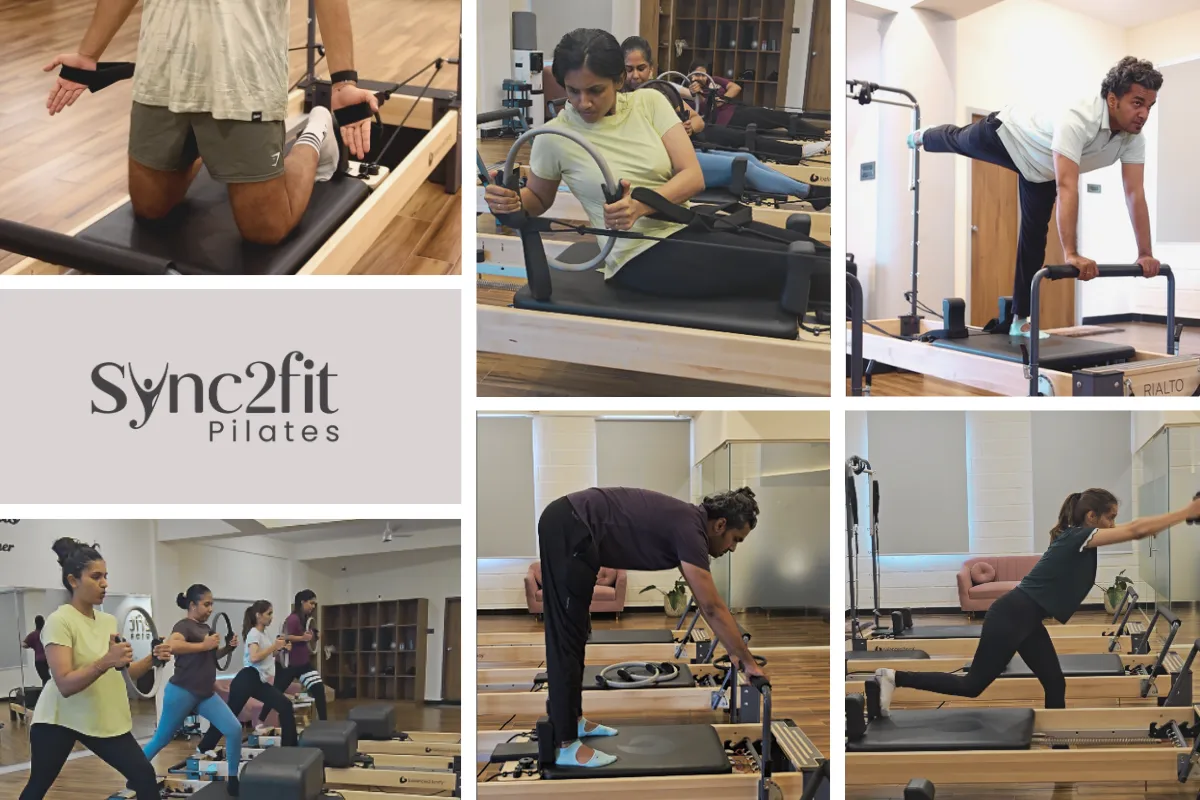
The Reformer uses springs, a moving carriage, straps and other components to provide adjustable resistance or assistance depending on the exercise.
This allows exercises to be modified according to the individual’s experience and ability.
For someone searching for Reformer Pilates Bangalore, the Reformer can provide a structured environment to work on the movement qualities that contribute to everyday mobility.
You can also explore our guide to Reformer Pilates vs. Mat Pilates.
10. Consistency Is What Makes the Difference
One Pilates session isn’t expected to transform the way you walk or climb stairs.
Movement improvements are developed through practice.
Regular sessions give you opportunities to repeatedly work on:
- Strength
- Stability
- Flexibility
- Balance
- Coordination
- Body awareness
- Movement control
This is why consistency can matter more than simply making every workout extremely intense.
Our article on why consistency matters more than intensity in Pilates explores this approach further.
Pilates Isn’t Just About What Happens Inside the Studio
One of the most useful ways to look at Pilates is through the lens of everyday movement.
A workout may last an hour, but your body continues moving for the rest of the day.
You walk to your car.
You climb stairs.
You stand up from your chair.
You bend down to pick something up.
You reach for something on a high shelf.
These movements require many of the same physical qualities that Pilates encourages you to practise.
That makes Pilates relevant beyond traditional fitness goals.
Can Beginners Use Pilates to Improve Everyday Mobility?
Absolutely. You don’t need to be highly flexible or athletic to begin.
Beginner sessions can focus on fundamental movements, breathing, alignment and basic strength before progressing to more challenging exercises.
If you’re new to Pilates, our Beginner’s Guide to Pilates Classes in Bengaluru can help you understand what to expect.
The important thing is to start at an appropriate level and learn proper technique under suitable instruction.
Build a Body That Moves With Confidence
Everyday mobility isn’t about performing impressive exercises.
It’s about being able to move through your day with control.
Walking, climbing stairs, standing, bending, reaching and changing direction are all part of an active lifestyle. Pilates can help you work on the strength, stability, flexibility, coordination and awareness that support these movements.
With consistent practice, your Pilates session can become more than an hour of exercise—it can become part of how you build a stronger relationship with everyday movement.
Looking for Pilates training in Bangalore? Start your movement journey with Sync2Fit Pilates and discover how controlled exercise can support the way you move every day.